
More Than Problem Solving
Insights on math literacy, instruction, and leadership for educators and school leaders.

This week, T.J. Vari and I published a piece in eSchool News making a case I care a lot about: that career-connected learning and durable skills belong in our classrooms, and that we should start building them earlier than we usually do. (Here’s the article.)
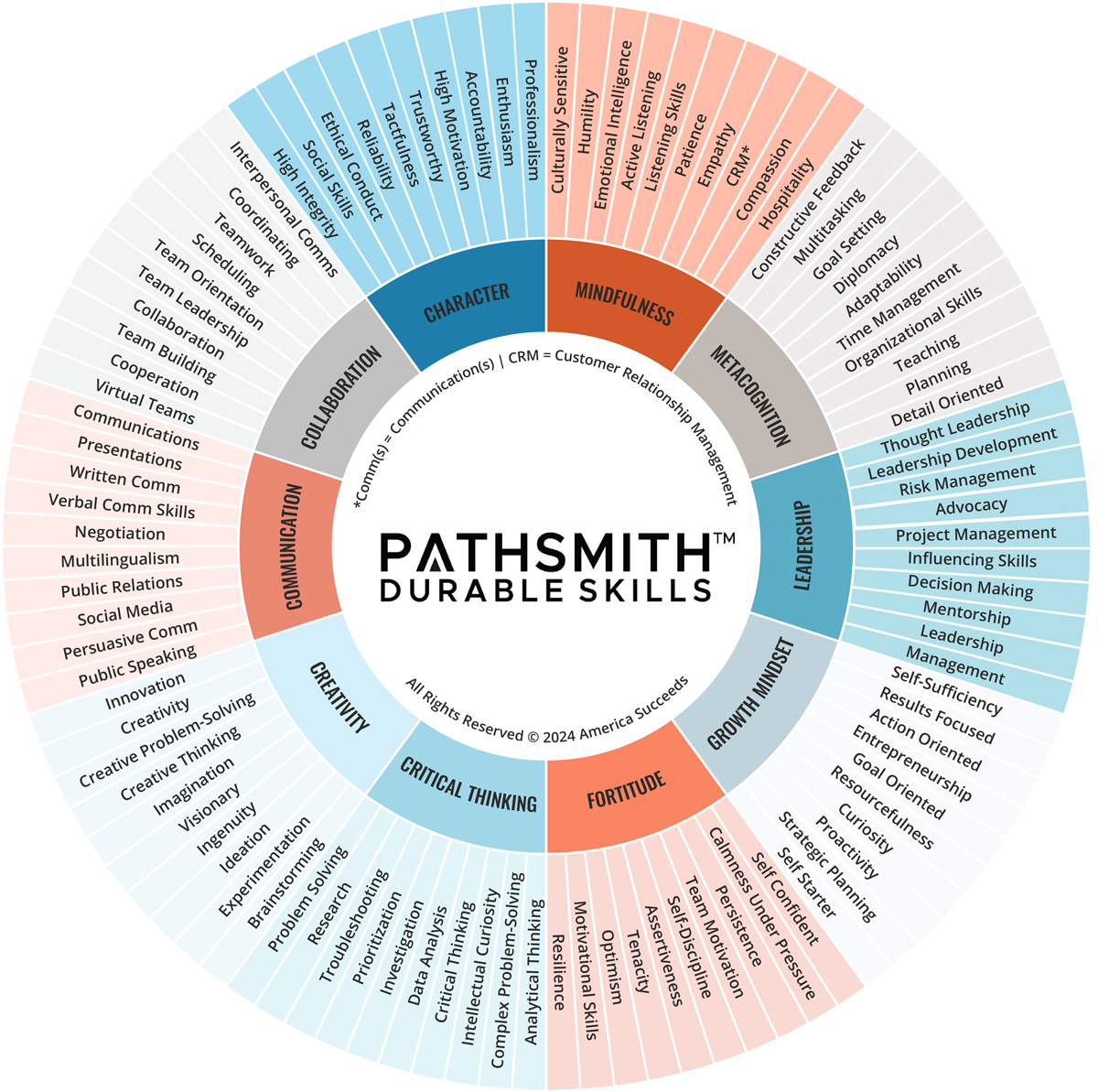
If you're unfamiliar with "durable skills," here's the quick summary. Durable skills are the human capabilities that stay valuable no matter how technology, tools, or job titles change: things like communication, critical thinking, collaboration, and creativity, along with character strengths like persistence, leadership, and adaptability. America Succeeds organizes them into a helpful map called the Durable Skills Advantage Framework, and PathSmith turns it into the wheel you'll see below. If you've never looked at it, it's worth a few minutes.
Here’s what I believe: these are skills we should be cultivating in every classroom, not just the ones where it comes easily.
And it does come more easily in some rooms than others, at least at first glance. There are content areas that lend themselves naturally to discussion, teamwork, and debate, and the teachers in those rooms see it clearly and lean right into it. Other subjects don’t make it as obvious, and math is often one of them.
When I taught sixth grade math, and even calculus, we chased excellence by cultivating humility. During turn-and-talks, I coached students to learn from each other: ask what your peers think first, then thank them for their feedback. That small habit leveled up our math while building real community in the room. And when I made mistakes (we all do), I acknowledged them publicly. Over time, students saw me do that consistently and with grace, and it helped normalize humility, one of the durable skills the framework's researchers identified.
Why is this the case? Math leans heavily on independent practice, and for good reason. I’ve written more than once about how powerful it is for building fluency and confidence, and that holds true. But just because it’s both beneficial for students to practice independently and it’s easy to assign independent work, does not mean that math class is not bursting with opportunities to cultivate durable skills. In fact, the need for students to explain their thinking, demonstrate understanding through multiple represenations, and think about how they are learning are all essential parts of a vibrant and rigorous math class. That’s a real missed opportunity, because math is actually a wonderful place to build durable skills — if we plan for it.
I get excited when I look at the array of skills included on the framework. There is a powerful overlap that exists between the durable skills and the Standards for Mathematical Practice from the Common Core. The overlap is striking.
“Construct viable arguments and critique the reasoning of others” is communication, critical thinking, and collaboration, almost word for word.
“Make sense of problems and persevere in solving them” is persistence and fortitude.
“Attend to precision” is exactly the careful, exact communication the framework prizes.
In other words, we are already supposed to be developing these skills in our schools and in our math classes, so we have an unique opportunity to blend those efforts into one cohesive vision. The durable-skills lens doesn't add a new burden, but rather gives both teachers and leaders broader language to see and name what good math practice has been expecting of our classrooms.
Monday Ready - Where Leaders Come In
So what’s the role of a leader in all this? You don’t have to choose between content and durable skills. Teachers don’t time to add things to class, instead we need to help them integrate the skills into class. Your role is not to add a new program onto math — it’s to help teachers see that how students are learning the math is already developing real, transferable skills, and that this development can be intentional rather than incidental.
Here’s how that can grow, one step at a time. You don’t have to start at the top.
Start with one teacher. Sit down with a single math teacher and ask which durable skill they’d most like to emphasize — one that will benefit their student and aligns with what they’re teaching. Then build a simple plan together: where it shows up in an upcoming unit, what it looks like when students are actually doing it, and how they’ll both know it’s working. One teacher, one skill, one plan. That’s a first step.
Build a vision with the department. Once a few teachers have tried it, gather the math department and create a shared vision: which durable skills matter most for your students, how they'll show up across courses, and what common language everyone will use. Now it's not one teacher's experiment. It's a department that knows what it's building and why.
Expand to grade- or school-wide. When the department has momentum, a few strands from the chart can anchor a grade-level or school-wide initiative, so the whole building is growing the same handful of skills on purpose, in math and well beyond it. That's when durable skills stop being a nice idea and start becoming part of how your school works.
More than Math
Math is too often overlooked in this conversation (or it gets credit for only a narrow slice of what it can build) usually just “problem solving.” But the overlap is already there in the standards we teach. Naming it, and choosing a few skills to grow on purpose, is the opportunity right in front of us.
Walk into a math class where students are arguing toward a defensible answer, revising their thinking, and saying precisely what they mean, and you'll see a much longer list of skills taking shape, skills that outlast every formula on the board. Our students won't remember most of the specific problems they solved. What I hope they carry with them is the more durable stuff: that their reasoning matters, that they can defend an idea and also change their mind, that precision is worth the effort.
That’s a real part of what I mean when I say math saves the world: not only the content, but the kind of thinkers, communicators, and collaborators a good math class can help students become.
My new book, Empowering All Leaders to be Math Leaders (Routledge, August 2026), goes deep on exactly how to make this happen — with tools you can put to work immediately in order to be “Monday Ready.” Subscribe here for more or find me at thomasobrien.xyz.