
Your Math Students Are Forgetting Everything. Here's the Fix.
Insights on math literacy, instruction, and leadership for educators and school leaders.

Here’s something that happens in math classrooms everywhere, every day.
A teacher delivers a solid lesson. Students follow along. The examples make sense in the moment. Class ends. Students go home.
And by the next week, half of it is gone.
This isn’t a motivation problem or a rigor problem. It’s a retention problem. And one of the most underused solutions sitting right in front of us is also one of the simplest: not just that students take notes in math class, but how.
Most math students either copy everything the teacher writes — passive, produces very little learning — or they write almost nothing at all. Either way, students have nothing they can actually use to study, review, or recover from confusion later. Without a structured system, they’re essentially starting over every time they sit down to do homework or prepare for a test.
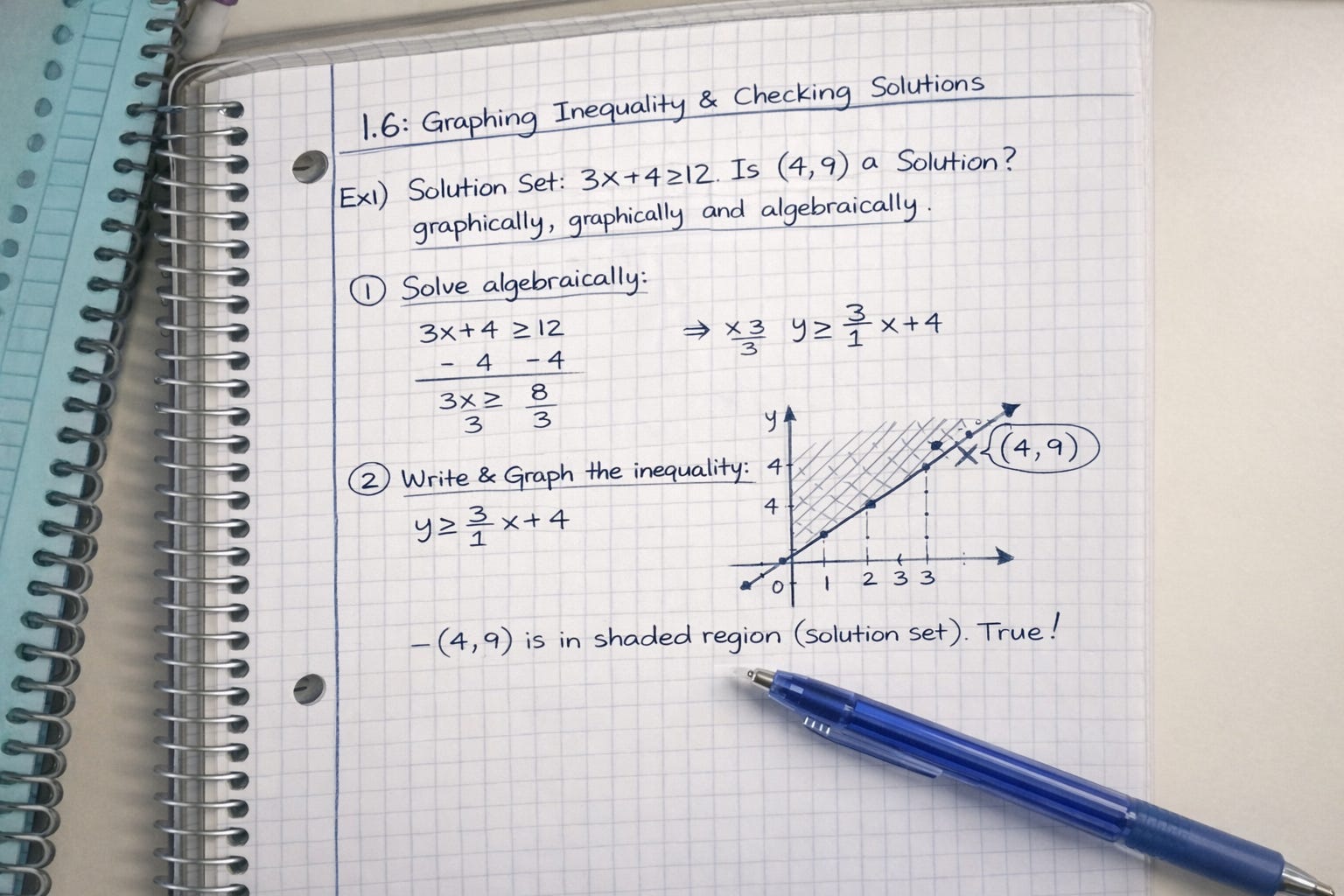
Why This Matters
Math is cumulative in a way few other subjects are - the content compounds. A gap in fractions shows up in ratios. A gap in ratios shows up in proportional reasoning. That gap shows up on the state assessment — and in Algebra 1, and beyond. When students don’t have a reliable system for encoding what they learn, those gaps compound quietly until they become very loud in April and May or two years later in a future math class.
Moreover, 2024 study published in Scientific American found that students who write notes by hand show significantly higher levels of brain connectivity across regions responsible for movement, vision, sensory processing, and memory compared to students who type. Typing is largely passive — the fingers transcribe while the brain disengages. Handwriting forces the brain to slow down, process, and make the information its own. That’s the difference between a note that sticks and one that doesn’t.
But here’s where most math classrooms fall short. It’s not enough to hand students a notebook and tell them to write things down. If teachers don’t intentionally design and coach the system — how notes are organized, what goes where, how students use them to review and recall later — you’ve done nothing but generate a pile of random pages that ends up in the recycling bin.
This is an executive functioning challenge as much as a math challenge. Teachers need to own the design and coaching of note-taking systems with the same intentionality they bring to lesson planning — explicitly teaching students how to use their notebooks, building in time to review and reference them, and treating the notebook as a study tool, not just a record of what happened in class that day.
For the classrooms where teachers do this well, the math notebook becomes a sacred artifact that students love and rely upon.
Monday Ready Ideas
Spring is the perfect time to tackle this — not to overhaul everything mid-year, but to plan intentionally for September. Here’s how to start.
Bring your math teacher leaders together for one working session with one question on the table: how do we want students to capture and use their learning next year in a notebook? Look at what teachers are currently doing. Compare it. Notice what’s working and what’s inconsistent.
Then design a shared notebook system together. This doesn’t mean every teacher does exactly the same thing — it means there’s a common structure students can count on. A format for worked examples. A place for their own practice. A section for capturing mistakes. Teachers bring their own personality to it. The architecture stays consistent so that students can learn the fundamentals in early years and reap the benefits of vertical continuity in later years.
Use department time this spring to prototype it. Have teachers build sample notebooks for one unit, share them, and refine the system together. Then present it to the full department before summer as the instructional anchor for the coming year.
Teachers walk into August with clarity. Students benefit from a clear and replicable system. You walk in with something concrete to look for in every classroom from day one.
That’s a strong foundation for a strong year of math learning
My new book, Empowering All Leaders to be Math Leaders (Routledge, August 2026), goes deep on exactly how to make this happen — with tools you can put to work immediately in order to be “Monday Ready.” Subscribe here for more or find me at thomasobrien.xyz.
The retention vs motivation framing is useful. I see the same pattern when I coach principals on walkthroughs. They watch the lesson but don't have a structured note system for what they observed, so by Friday's leadership meeting it's all a blur. Curious whether you've found a version of this note design that works for adults learning from classroom observation.